
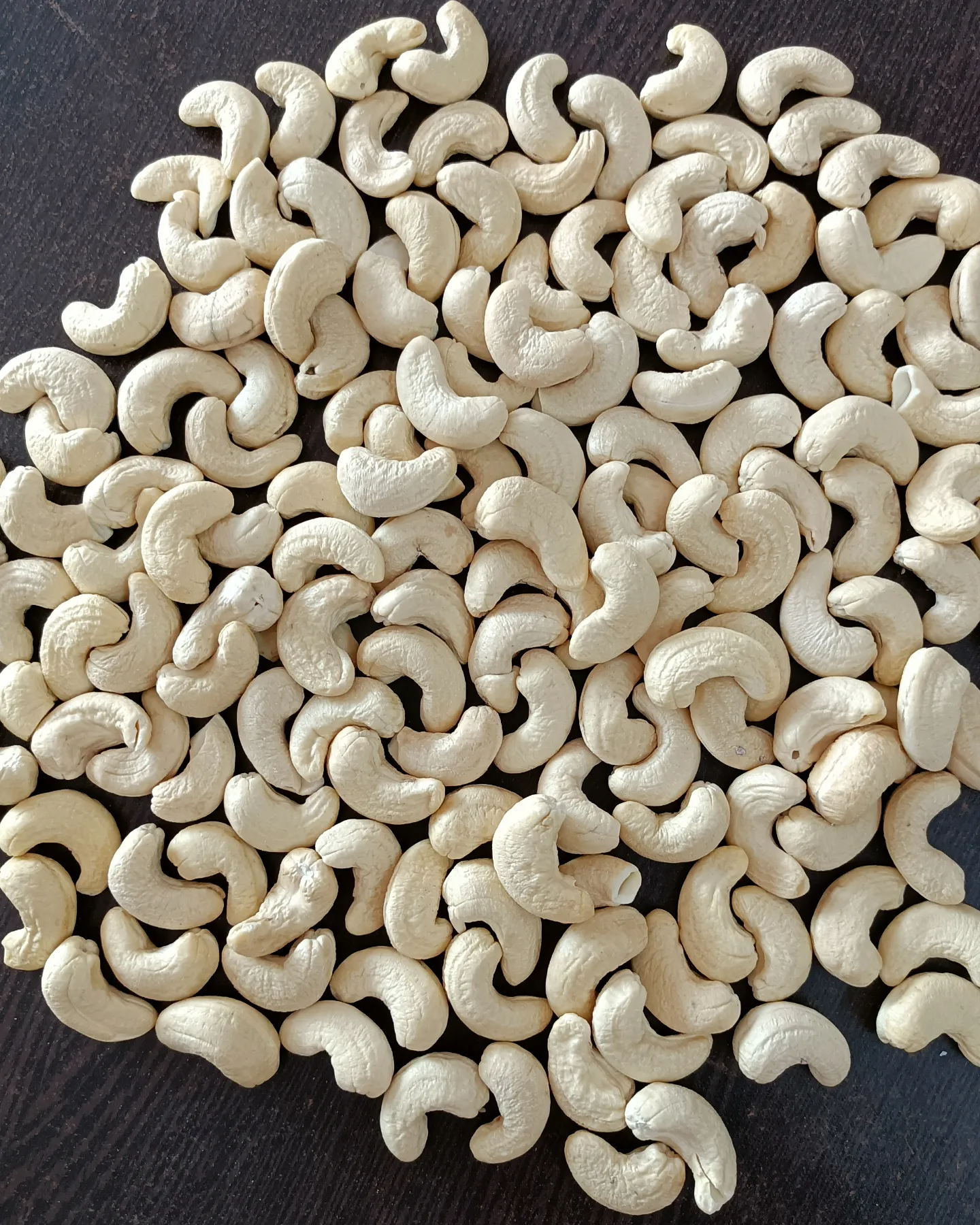
W320 cashew nuts are among the most widely traded cashew kernel grades in the international market. They are popular with food manufacturers, wholesalers, importers, retailers, and distributors because they offer a practical balance of size, appearance, versatility, and cost.
Whether you are sourcing cashew kernels for retail packaging, manufacturing snacks, supplying supermarkets, or distributing ingredients to food businesses, understanding W320 cashews can help you make better purchasing decisions.
But what exactly does W320 mean? How does this grade compare with W240 and W450? What should you look for when buying in bulk, and how can you tell whether a supplier offers consistent quality?
This guide covers everything you need to know about W320 cashew nuts, from grading and processing to storage, pricing factors, and choosing a reliable supplier.
What Are W320 Cashew Nuts?
W320 cashew nuts are whole, white cashew kernels that generally meet the commercial specifications for the W320 grade.
The term W320 describes two things:
- W stands for White, referring to the kernel’s colour classification.
- 320 refers to the approximate number of kernels per pound, based on the grading standard.
In practical terms, W320 cashews typically contain around 300 to 320 kernels per pound, depending on the applicable grading specification. Since a pound is approximately 454 grams, this corresponds to roughly 660 to 705 kernels per kilogram.
W320 cashews are usually medium sized whole kernels. They are large enough to offer an attractive appearance in retail packs but small enough to work well in many food manufacturing applications.
They are commonly sold as raw, unroasted kernels, although roasted, salted, flavoured, and other processed versions may also be available.
It is important to distinguish the grade from the product’s processing method. W320 describes the kernel grade, not whether the cashews are organic, roasted, salted, or certified for a particular market.
Why Are W320 Cashew Nuts Popular?
W320 cashews have established a strong position in the international cashew trade because they suit a wide range of commercial requirements.
1, A practical balance between size and price: Larger grades, such as W180 and W210, generally contain fewer kernels per pound because the individual kernels are bigger. These grades may command higher prices. W320 cashew nuts offer a middle ground. They provide the appearance of whole kernels without necessarily carrying the cost associated with the largest grades. For buyers who need consistent quality at a competitive price, this can make W320 a sensible option.
2, Versatility across different industries: W320 cashews are suitable for several applications, including:
- Retail packs of whole cashew nuts
- Roasted and salted cashew snacks
- Trail mixes and nut assortments
- Bakery products, biscuits, and confectionery
- Chocolate and dessert ingredients
- Foodservice and catering
- Ingredient supply for food manufacturers
Their versatility allows businesses to use the same grade across different product lines, depending on their processing requirements.
3, Consistent presentation: Whole kernels are often preferred for products where appearance matters. For example, a retail pack of premium cashews benefits from having intact kernels with a reasonably uniform size and colour.
W320 cashew nuts are often selected for this reason. However, the grade alone does not guarantee that every shipment will have identical colour, shape, moisture content, or defect levels. Buyers should confirm the supplier’s actual specifications before placing an order.
4, Broad international demand: W320 cashews are traded across many markets, including Europe, the United Kingdom, North America, the Middle East, and Asia. Importers and distributors often favour this grade because it can serve multiple customer segments, from food manufacturers to retail and wholesale businesses.
Demand, pricing, and availability still vary according to origin, crop conditions, processing capacity, freight costs, and market conditions.
W320 Cashew Kernels for the European and Netherlands Markets
Businesses importing cashew kernels into Europe or the Netherlands should assess both commercial quality and regulatory compliance. Requirements vary according to the destination, product, and intended use. Buyers should verify applicable rules before shipment rather than relying solely on a supplier’s general export experience
Areas to review include:
-Food safety and hygiene requirements
-Contaminant and pesticide residue limits
-Microbiological requirements where applicable
-Allergen declarations and labelling
-Country-of-origin and traceability information
-Import documentation and customs requirements
-Packaging and shelf-life information
-Applicable food safety certifications requested by customers
Cashews are tree nuts and are subject to allergen labelling requirements in relevant markets. Businesses repacking or manufacturing products containing cashews should also assess cross contact risks and provide accurate allergen information.
If you supply supermarkets, food manufacturers, or established distributors, their own supplier approval procedures may include additional testing, audits, insurance, and certification requirements.
Some Frequently Asked Questions About W320 Cashew Nuts
Are W320 cashew kernels good quality?
W320 is a widely traded whole white kernel grade. It can be an excellent choice for retail, wholesale, and food manufacturing, provided the shipment meets the agreed specification. Quality also depends on factors such as freshness, colour, defects, storage, and food safety.
Are W320 cashew grade bigger than W240?
No. W240 kernels are generally larger because fewer kernels fit into one pound. W320 kernels are typically medium-sized whole cashews.
Can W320 cashews be used for roasting?
Yes. W320 kernels can be roasted and seasoned. Buyers should specify whether they need raw kernels for further processing or a finished roasted product.
How can I buy W320 cashews in bulk?
Start by defining your grade, quality, quantity, packaging, destination, and delivery requirements. Request a written quotation, product specification, and sample, then verify the supplier’s documentation and compare the total landed cost before placing an order.
To conclude W320 cashew nuts are a versatile option for businesses that need whole cashew kernels for retail packaging, wholesale distribution, roasting, foodservice, or food manufacturing. Their appeal comes from a useful combination of medium sized kernels, broad commercial applications, and availability through established international supply chains. However, the grade should be only one part of your purchasing decision. Consistent quality, clear specifications, reliable documentation, suitable packaging, and dependable delivery all contribute to a successful purchase.
Looking for premium W320 cashew kernels for wholesale or bulk supply? Contact our team to discuss your required quantity, packaging, destination, and quality specifications. We can help you identify a suitable option for your business needs