
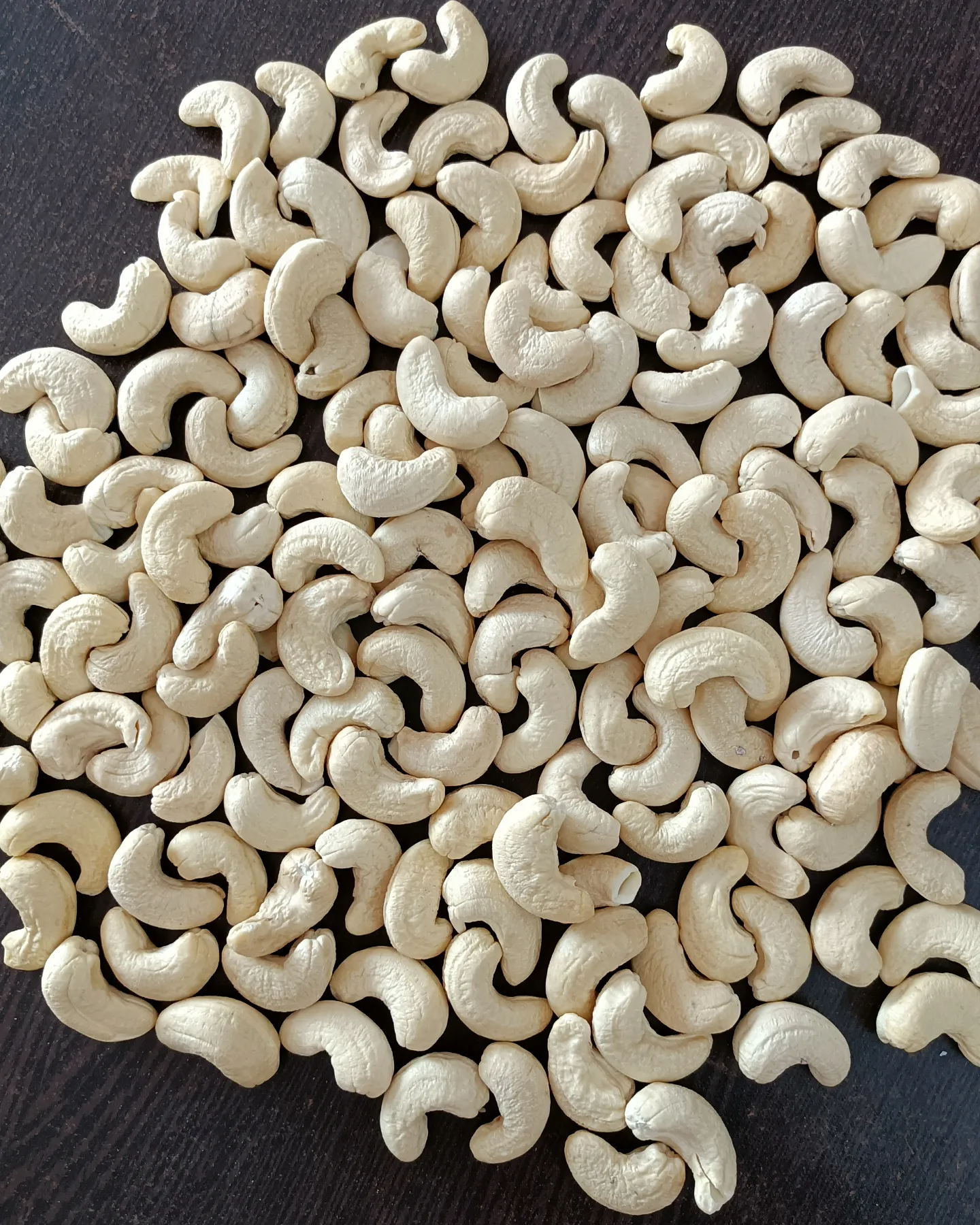
W320 cashew nuts are among the most widely traded cashew kernel grades in the international market. They are popular with food manufacturers, wholesalers, importers, retailers, and distributors because they offer a practical balance of size, appearance, versatility, and cost. Whether you are sourcing cashew kernels for retail packaging, manufacturing snacks, supplying supermarkets, or distributing ingredients to food businesses, understanding W320 cashews can help you make better purchasing decisions. But what exactly does W320 mean? How does this grade compare with W240 and W450? What should you look for when buying in bulk, and how can you tell whether a supplier offers consistent quality? This guide covers everything you need to know about W320 cashew nuts, from grading and processing to storage, pricing factors, and choosing a reliable supplier. What Are W320 Cashew Nuts? W320 cashew nuts are whole, white cashew kernels that generally meet the commercial specifications for the W320 grade. The term W320 describes two things: W stands for White, referring to the kernel’s colour classification. 320 refers to the approximate number of kernels per pound, based on the grading standard. In practical terms, W320 cashews typically contain around 300 to 320 kernels per pound, depending on the applicable grading specification. Since a pound is approximately 454 grams, this corresponds to roughly 660 to 705 kernels per kilogram. W320 cashews are usually medium sized whole kernels. They are large enough to offer an attractive appearance in retail packs but small enough to work well in many food manufacturing applications. They are commonly sold as raw, unroasted kernels, although roasted, salted, flavoured, and other processed versions may also be available. It is important to distinguish the grade from the product’s processing method. W320 describes the kernel grade, not whether the cashews are organic, roasted, salted, or certified for a particular market. Why Are W320 Cashew Nuts Popular? W320 cashews have established a strong position in the international cashew trade because they suit a wide range of commercial requirements. 1, A practical balance between size and price: Larger grades, such as W180 and W210, generally contain fewer kernels per pound because the individual kernels are bigger. These grades may command higher prices. W320 cashew nuts offer a middle ground. They provide the appearance of whole kernels without necessarily carrying the cost associated with the largest grades. For buyers who need consistent quality at a competitive price, this can make W320 a sensible option. 2, Versatility across different industries: W320 cashews are suitable for several applications, including: Retail packs of whole cashew nuts Roasted and salted cashew snacks Trail mixes and nut assortments Bakery products, biscuits, and confectionery Chocolate and dessert ingredients Foodservice and catering Ingredient supply for food manufacturers Their versatility allows businesses to use the same grade across different product lines, depending on their processing requirements. 3, Consistent presentation: Whole kernels are often preferred for products where appearance matters. For example, a retail pack of premium cashews benefits from having intact kernels with a reasonably uniform size and colour. W320 cashew nuts are often selected for this reason. However, the grade alone does not guarantee that every shipment will have identical colour, shape, moisture content, or defect levels. Buyers should confirm the supplier’s actual specifications before placing an order. 4, Broad international demand: W320 cashews are traded across many markets, including Europe, the United Kingdom, North America, the Middle East, and Asia. Importers and distributors often favour this grade because it can serve multiple customer segments, from food manufacturers to retail and wholesale businesses. Demand, pricing, and availability still vary according to origin, crop conditions, processing capacity, freight costs, and market conditions. W320 Cashew Kernels for the European and Netherlands Markets Businesses importing cashew kernels into Europe or the Netherlands should assess both commercial quality and regulatory compliance. Requirements vary according to the destination, product, and intended use. Buyers should verify applicable rules before shipment rather than relying solely on a supplier’s general export experience Areas to review include: -Food safety and hygiene requirements -Contaminant and pesticide residue limits -Microbiological requirements where applicable -Allergen declarations and labelling -Country-of-origin and traceability information -Import documentation and customs requirements -Packaging and shelf-life information -Applicable food safety certifications requested by customers Cashews are tree nuts and are subject to allergen labelling requirements in relevant markets. Businesses repacking or manufacturing products containing cashews should also assess cross contact risks and provide accurate allergen information. If you supply supermarkets, food manufacturers, or established distributors, their own supplier approval procedures may include additional testing, audits, insurance, and certification requirements. Some Frequently Asked Questions About W320 Cashew Nuts Are W320 cashew kernels good quality? W320 is a widely traded whole white kernel grade. It can be an excellent choice for retail, wholesale, and food manufacturing, provided the shipment meets the agreed specification. Quality also depends on factors such as freshness, colour, defects, storage, and food safety. Are W320 cashew grade bigger than W240? No. W240 kernels are generally larger because fewer kernels fit into one pound. W320 kernels are typically medium-sized whole cashews. Can W320 cashews be used for roasting? Yes. W320 kernels can be roasted and seasoned. Buyers should specify whether they need raw kernels for further processing or a finished roasted product. How can I buy W320 cashews in bulk? Start by defining your grade, quality, quantity, packaging, destination, and delivery requirements. Request a written quotation, product specification, and sample, then verify the supplier’s documentation and compare the total landed cost before placing an order. To conclude W320 cashew nuts are a versatile option for businesses that need whole cashew kernels for retail packaging, wholesale distribution, roasting, foodservice, or food manufacturing. Their appeal comes from a useful combination of medium sized kernels, broad commercial applications, and availability through established international supply chains. However, the grade should be only one part of your purchasing decision. Consistent quality, clear specifications, reliable documentation, suitable packaging, and dependable delivery all contribute to a successful purchase. Looking for premium W320 cashew kernels for wholesale or bulk supply? Contact our team to
How Cashews Are Processed
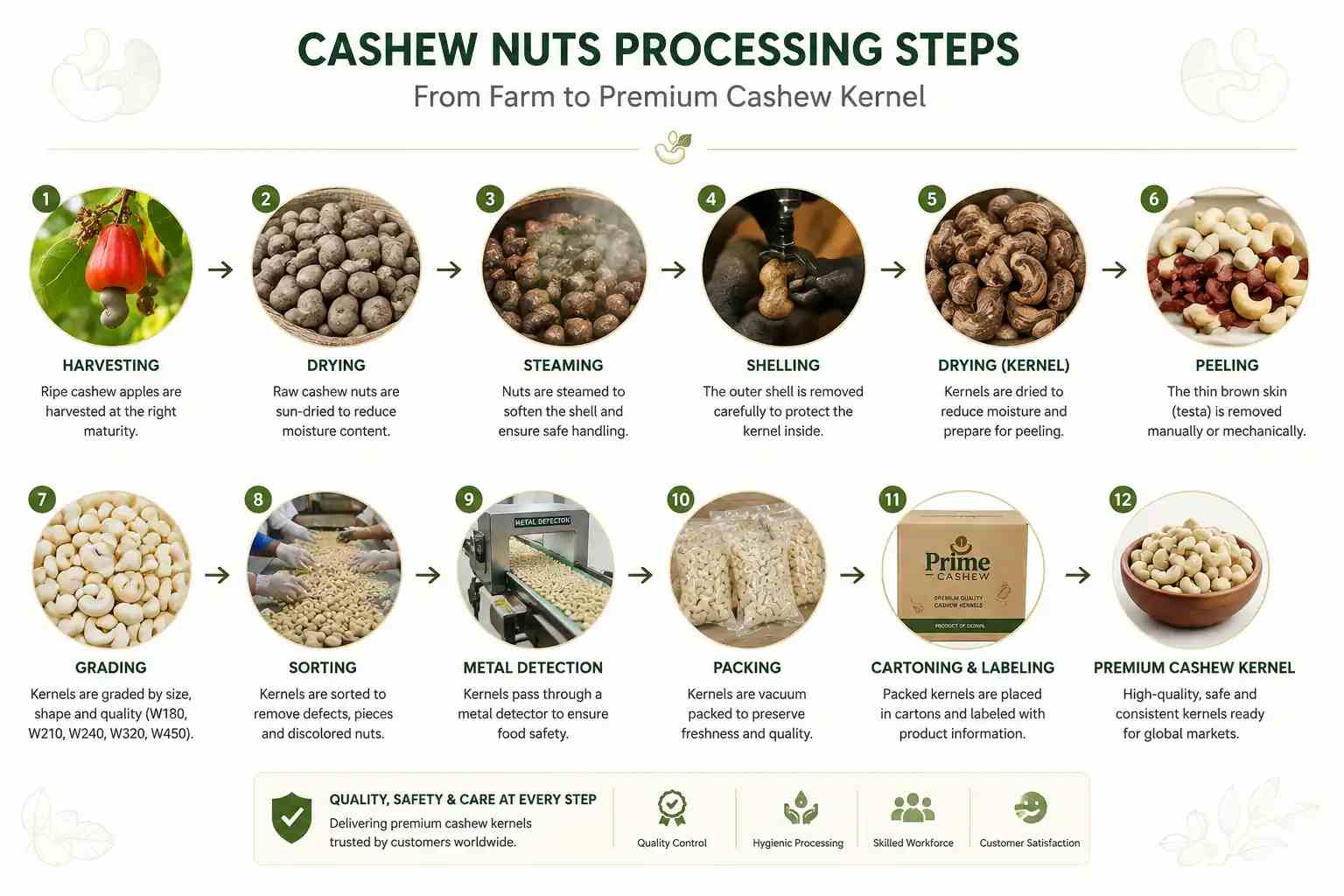
How Cashew nuts are processed from farms to premium cashew kernels. When you buy cashew kernel, it is easy to focus only on the finished product. You see clean ivory-colored kernels that re ready for roasting, packaging, or use in food manufacturing. What many buyers do not see is the long journey each kernel takes before it reaches is final destination. Every high quality cashew kernels begins with careful sourcing of quality RCN by the cashew processing company from farmers, followed by a series of processing steps that require experience, attention to details and strict quality control. From harvesting the raw cashew nuts (RCN) to grading, sorting and packing of the finished kernels, every stage influences the quality of the final product. For business buying bulk cashew nuts, understanding this process is important. It helps explain why some suppliers consistently deliver premium kernels while others struggle with broken pieces, inconsistent grades, or quality issues. Harvesting Begins The Quality Journey . The production of premium cashew kernels by a cashew processing company starts in the orchard. Cashew apples naturally fall from their trees when they re mature carrying the raw cashew nuts (RCN) attached underneath. Farmers collect the fallen fruits rather than picking them too early. This ensures the nuts have reached fully maturity, which contributes to better nuts development and overall quality. After harvesting the raw cashew nuts (RCN) are separated from the cashew apples and dried in the sun for several days. Drying reduces moisture and helps preserve the nuts before there re move to the processing facility. Proper drying is important because excess moisture can lead to mold, spoilage or reduces shelf life during storage and transportation. Cleaning And Storage. Once the raw cashew nuts (RCN) arrives at the processing facility, they are clean to stones, dust, leaves, and other foreign materials. The nuts are then stored under controlled conditions until processing begins. Proper storage prevent the raw materials from humidity and paste while maintaining its quality Experiences processors carefully monitor storage conditions because even small changes in the moistures can affect the kernels inside the shell. Steaming Makes Shelling Safer . Raw cashew shells contain a natural occurring liquid called cashew nuts shelled liquid commonly know as CNSL. This liquid can irritate the skin if handled improperly. To make shelling safer and easier, the raw nuts a steamed under controlled temperature and pressure. Steaming softens then shell while reducing the risk associated with shell oil. At the same time, careful steaming helps protect the kernels from damaging during shell removal. Shelling The Cashew Nuts . Shelling is one of the most important stage in cashew kernel processing . The objective is simple but challenging . Remove the shell without breaking the valuable kernel inside. Modern processing plants combine mechanical equipment with skilled workers to achieve the highest possible percentage of whole kernels . Good shelling methods directly influence the availability of premium grades kernels such as W180, W240 and W320 . Drying The Kernels . After shelling, the kernels still have this brown skin know as the testa . This stage requires patience and precision because damaging the kernels reduce the percentage of whole grades. Many processing facilities still rely of on experience workers for pilling because the human eye and hand remain highly effective at protecting delicate kernels . Grading According To International Standards . Grading is where the kernels are separated according to size, appearance and quality. This is one of the most important steps for international buyers . Whole kernels are graded into recognized categories such as, W180, W210, W240, W320 and W450 The letter “W” stands for whole while the numbers indicates approximately how many kernel are contained in a pound according INC . Lower number generally represent larger kernels and vise versa . Each grades serves different markets depending on costumers preference and price requirements . Food manufacturers, supermarkets, snack companies, and private label brands often select different grades depending on their products Quality Inspection . Quality control continues throughout the entire production process . Kernel size consistency Color Moisture content Defects Broken kernels Foreign materials Professional quality teams also verify that the kernels comply with costumer specifications and export requirements . Metal Detection and Food Safety . Modern facilities include metal detectors before final packing . Metal detection helps ensure that no metal fragments accidentally enters the finished products . Along with good hygiene practices, sanitation procedures, and regular inspection, this contributes to safer food products for consumers around the world . Food safety has become an essential requirement for companies supplying international markets Vacuum Packaging Preserve Freshness . Cashew kernels naturally contain healthy oils . Exposure to oxygen can gradually reduce freshness . To protect product quality, premium cashew kernels are packed in vacuum sealed bags before being placed inside export cartons . Vacuum packing helps maintain freshness during long distance shipping while extending shelf life . Proper packing also reduces the risk of moisture entering the product during transportation . Preparing For Export . Once packed the cartons are labelled with important product information including : Grade Net weight Country of origin Batch information The cartons are then loaded into shipping containers under appropriate conditions before export . Reliable logistics planning helps ensure buyers receive products in excellent conditions regardless of the shipping destination . As a trusted wholesale cashew nuts exporter, careful documentation and efficient shipping are just as important as quality processing . Why Processing Matters To Wholesale Cashew Nuts Buyers. Many buyers compare wholesale cashew nuts suppliers based only on price . While pricing is important, processing quality has a direct impact on the value you receive . Better processing means Higher percentage of whole kernels . More consistent grade . Longer shelf life . Fewer damage kernels . Better colour and appearance . Improve costumer satisfaction . For business purchasing wholesale cashew nuts, working with an experience processor often result in fewer quality issues, and stronger long-term business relationship . Choosing The Right Cashew